




“Put your shoes on.”
“Please put your shoes on.”
“We’re leaving in five minutes. Put your shoes on.”
“Why are you playing with that? I asked you to put your shoes on!”
If this sounds familiar, you are in very good company. Many parents worry that their child does not listen, cannot stay focused, acts before thinking or becomes overly excited. Sometimes it feels as though the same instruction has to be repeated five times before anything happens.
These challenges can show up at home, school or during extracurricular activities. They often become more obvious when a child joins a group and suddenly has to wait, listen and remember instructions. At the same time, they must control their body while surrounded by other excited children.
Adults can easily label this as a behaviour problem, and behaviour may certainly play a role. However, children are also still developing skills that adults often take for granted. These include shifting attention, controlling impulses, managing frustration and stopping something enjoyable when asked.
Those abilities improve through practice. That is one reason structured activities, including martial arts, can be valuable for some children.
Focus and Self-Control Are Not Simply Personality Traits
We sometimes talk about focus as though children either have it or they do not. One child seems to concentrate easily, while another appears unable to stay on task. In reality, focus changes depending on the situation.
A child may concentrate intensely on LEGO, drawing or a favourite game. Five minutes later, that same child may struggle to listen while getting ready for school. Another child may focus well one-on-one but become distracted in a group.
Self-control works in much the same way. A child may know they should wait their turn and still blurt something out. They may understand that hitting a sibling is wrong but react before thinking when angry. Losing a game can also overwhelm a child who knows perfectly well how they are expected to behave.
Knowing what to do and doing it consistently are two different skills.
Attention, working memory, emotional regulation and the ability to shift between tasks all contribute to executive functioning. Children continue developing these abilities throughout childhood. They help a child manage behaviour, emotions and attention.
Instead of only asking, “Why won’t my child control themselves?” parents can ask a more useful question: Where does my child regularly get the chance to practise self-control?
Not Every Child Who Struggles to Focus Is Being Defiant
This distinction matters because behaviour does not always tell us what is happening underneath.
A child who ignores an instruction may simply be refusing to cooperate. However, they may also be deeply absorbed in another task or may not have processed everything you said. Sometimes an instruction includes too many steps. Fatigue, overstimulation, frustration and age can also affect how well a child responds.
Attention and impulse-control challenges may also occur with ADHD or other developmental differences. That does not mean every active, distracted or impulsive child has a diagnosis. Parents should avoid drawing conclusions from a few frustrating behaviours.
If these difficulties regularly affect learning, relationships or daily life, speak with appropriate healthcare and educational professionals. Martial arts may provide a useful activity for some children, but it does not replace professional assessment or treatment.
The dojo is not a clinic, and a black belt is not a prescription. Keeping that distinction clear helps parents make better decisions.
So Why Might Martial Arts Help?
Martial arts gives children something they need to improve almost any skill: repetition with feedback.
Consider what happens during a well-designed children’s martial arts class. The instructor gives a direction and demonstrates a technique. Students watch, remember what they saw and try it themselves. After feedback, they make an adjustment and try again.
That cycle may happen dozens of times during one class. The techniques are easy to see, but another kind of training is happening underneath. Students also practise attention, patience, listening, body awareness, impulse control and emotional regulation.
Research into martial arts and executive functioning in children continues to develop. Some studies have found improvements in attention, inhibition and cognitive control after structured martial arts programs. Researchers also caution that we need stronger evidence before treating martial arts as a clinical intervention.
That is a more useful conclusion than claiming martial arts automatically creates disciplined children. It does not. What martial arts can offer is a place where children practise discipline repeatedly.
Children Practise Starting and Stopping
Some of the simplest activities in a martial arts class teach an important skill: changing gears.
Students move, stop, listen and reset. They may run toward a target, perform a technique and return to their position. During another drill, they might react quickly and then become still enough to hear the next instruction.
Children who become excited easily often find stopping harder than starting. Martial arts gives them many opportunities to practise both.
That ability matters far beyond the dojo. Children need it when recess ends, screen time is over or the teacher changes subjects. They also need it when bedtime arrives or the family has to leave somewhere fun.
Learning to stop does not mean suppressing energy. It means gaining more control over when and how that energy comes out.
Movement Gives Attention Somewhere to Go
Some children pay attention more easily when their body is involved. Asking a very energetic child to “sit still and focus” can sometimes feel like telling water not to be wet.
Martial arts takes a different approach because children have to concentrate while moving. They may watch an instructor’s feet, remember which hand moves first and react to a target. At the same time, they need to avoid other students and listen for the command to stop.
This combination of physical activity and mental challenge makes martial arts different from simply trying to tire a child out.
The Canadian Paediatric Society recognizes the broad benefits of physical exercise. It also includes exercise within a comprehensive and individualized approach to supporting children with ADHD.
Movement can help. Purposeful movement adds another layer because it requires attention, decision-making and control.
Children Receive Immediate Feedback
Many everyday situations delay the consequences of poor focus. A child might miss part of an assignment at school and only discover the problem later. Forgetting to practise may not matter until several weeks have passed.
Martial arts often provides much faster feedback.
If a student looks away during a demonstration, they may move in the wrong direction. Forgetting a sequence may force them to stop and reset. When a technique lacks control, the instructor can correct it immediately and offer another attempt.
The goal is not punishment. The child begins connecting an action with its result, then learns how to adjust.
With enough practice, students often start noticing their own mistakes. That is an important step because they become less dependent on adults constantly directing them.
Self-Control Becomes Physical
Parents often tell children to “control themselves,” but those words can feel abstract. Martial arts turns control into something children can see and feel.
A student may have to perform a punch quickly but stop at the proper point. They might hold a pad safely for a partner or practise a grappling skill without hurting anyone. Another exercise may require patience while someone else takes a turn.
Students also learn to move with intensity and then settle quickly enough to listen.
These experiences show children that power and lack of control are not the same thing. In fact, greater martial arts skill requires greater responsibility.
This lesson can be especially useful for children who have lots of physical energy. The goal does not have to be reducing that energy. A better goal is helping them understand how and when to use it.
Children Learn to Deal With Frustration
Martial arts gives children plenty of opportunities to become frustrated. A technique does not work, another student learns it faster or an instructor gives a correction. A child may forget part of a kata, struggle during a drill or fail to earn the belt they hoped for.
Those moments rarely feel beneficial while they are happening. However, learning to experience frustration without lashing out or immediately quitting forms an important part of self-control.
A good instructor does not remove every difficult moment. Instead, they help the child navigate it.
Sometimes the student needs encouragement. At other times, the instructor may break the skill into smaller pieces or allow a brief reset. There are also moments when the best approach is simply a calm expectation that the child tries again.
Children do not develop resilience by avoiding frustration. They develop it by gradually discovering that frustration does not have to control what happens next.
Progress Rewards Consistency
Martial arts also gives children visible evidence that effort can produce progress.
Skills improve with practice, techniques become easier and belts eventually change. Something that felt impossible several months earlier may become almost automatic.
That experience helps children connect attention and effort with improvement. They begin to see that progress is not reserved for people with natural talent. Showing up, listening, practising, making mistakes and trying again also matter.
For some children, experiencing that lesson has more impact than hearing another adult tell them to focus.
But Will Martial Arts Fix My Child’s Behaviour?
No, and parents should be suspicious of any martial arts school that promises otherwise.
Children are complicated human beings, not malfunctioning appliances. A child who struggles at home may behave very differently in a martial arts class. Another may concentrate well during Karate but still have difficulty organizing homework.
Some children also need educational, developmental, behavioural or medical support that martial arts cannot provide.
Research into martial arts and children’s cognitive or behavioural development shows promise in several areas. However, the evidence does not support treating martial arts as a cure or guaranteed solution.
What martial arts can provide is an environment where children regularly practise many behaviours parents want to see more often. Students listen, wait, adjust, take responsibility and control their bodies. They also learn to manage disappointment, respect others and continue working when something feels difficult.
The value does not come from martial arts magically switching on self-control. It comes from giving children repeated chances to practise it.
The Right Martial Arts School Matters
Simply enrolling a child in martial arts does not guarantee these benefits. The instructor and learning environment make a tremendous difference.
If your child struggles with focus, impulsivity or self-control, look for instructors who understand that children are not small adults. Watch a class and notice how the staff communicate. Clear directions, active engagement and calm redirection usually tell you more than a list of impressive credentials.
Pay attention to how instructors respond when a child becomes distracted. Do they redirect the student without embarrassment? Are expectations consistent? Do they recognize effort while still maintaining standards?
The class should also have enough structure to feel predictable without becoming joyless.
Most importantly, consider whether the instructor seems interested in understanding individual children. One student may need an occasional reminder, while another becomes overwhelmed by noise. An enthusiastic and impulsive child may need a different approach than a student who shuts down after correction.
Good teaching requires instructors to notice those differences and respond appropriately.
What If My Child Has ADHD, Autism or Other Developmental Differences?
There is no single answer because children with the same diagnosis can have very different needs.
One child with ADHD may thrive on movement, repetition and clear routines. Another may find a busy group environment difficult. An autistic child may enjoy the predictability of martial arts but struggle with noise, transitions or physical contact.
Parents should speak openly with the school about their child’s needs. Ask how instructors work with different learning styles and how they handle situations that may overwhelm a student.
The Canadian Paediatric Society emphasizes individualized approaches when supporting children with ADHD. It does not assume that one intervention will work for every child. The same common sense should apply inside a martial arts school.
Rather than asking only, “Is martial arts good for children with ADHD?” or “Is martial arts good for autistic children?” consider a more useful question: Is this particular program, with these particular instructors, a good fit for my child?
That is a question worth exploring carefully.
How Can Parents Tell if Martial Arts Is Helping?
Do not judge progress only by how quickly your child earns belts. Many of the most meaningful changes are easy to miss at first.
Perhaps your child recovers from correction more quickly or remembers their equipment more often. They may wait a little longer before interrupting or settle down faster after becoming excited. Some children start attempting difficult tasks before asking for help.
Others gradually recognize when their attention has wandered. You may also notice more control when they work with another child.
These changes often happen slowly, and that is normal. Learning self-control is not a six-week project. Most adults are still working on it too.
How We Approach This at Okami Kai
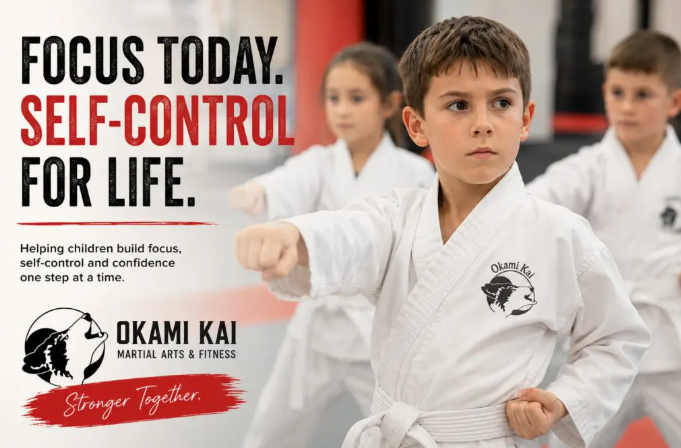
At Okami Kai Martial Arts and Fitness in Uxbridge, we certainly teach children how to punch, kick, move, grapple and defend themselves. Those techniques also give us opportunities to develop skills that reach well beyond martial arts.
Students need to listen before they move. They learn to control techniques around other people, accept correction and try again. Over time, they begin to understand that excitement does not have to become chaos. Frustration does not have to lead to quitting, and strength does not require losing control.
We also recognize that different ages and different children need different approaches. Our goal is not to force every student into the same mould. Instead, we give children appropriate challenges and gradually raise expectations as their skills and maturity develop.
Sometimes parents come to us looking for Karate. What they may really want is a place where their child can belong, move and learn. They want an environment where their child can struggle safely, gain confidence and discover what they are capable of doing.
Martial arts cannot solve every parenting challenge. However, the right environment can become another strong and positive influence in a child’s life. For some families, that is exactly what they have been looking for.
Frequently Asked Questions
Can martial arts help my child focus?
Martial arts requires children to watch, listen, remember instructions and move with purpose. It also asks them to respond to changing situations. Research into martial arts and executive functioning shows promise, but parents should view martial arts as a chance to practise attention rather than a guaranteed treatment.
Is martial arts good for a child who does not listen?
It can suit some children because instructors often use short directions followed by immediate physical practice. The quality of the instructor and class structure matters greatly. A poorly organized martial arts class will not improve anyone’s listening.
Can martial arts help an energetic child?
Martial arts can give energetic children a physical outlet while also asking them to slow down and listen. They must control their movements rather than simply burn off energy. That combination of movement and structure can work well for some children.
Should I put my child in martial arts because they have behaviour problems?
Behaviour difficulties can have many causes. Martial arts may offer useful structure and regular opportunities to practise self-control. Persistent or serious concerns should also involve appropriate healthcare or educational professionals.
Is martial arts good for children with ADHD?
Some children with ADHD respond well to movement, routines, feedback and structure. Others may need adaptations or simply prefer another activity. Martial arts should complement appropriate professional care when needed, not replace it.
A Final Thought for Parents
Repeating instructions, reminding a child to slow down and wondering whether anything is getting through can become exhausting. Most parents dealing with these challenges are not looking for perfection. They simply want to see progress.
The goal is not to create a child who never becomes distracted, excited or frustrated. We want children to recognize those moments and gradually become better at deciding what to do next. Developing that ability takes time and practice, and a good martial arts class can provide plenty of both.
For families in Uxbridge, Port Perry, Sunderland and the surrounding communities, Okami Kai Martial Arts and Fitness offers children’s programs that combine physical skill development with structure, appropriate challenge, confidence and self-control.
Sometimes the best way to decide whether that environment suits your child is to come and see it for yourself.